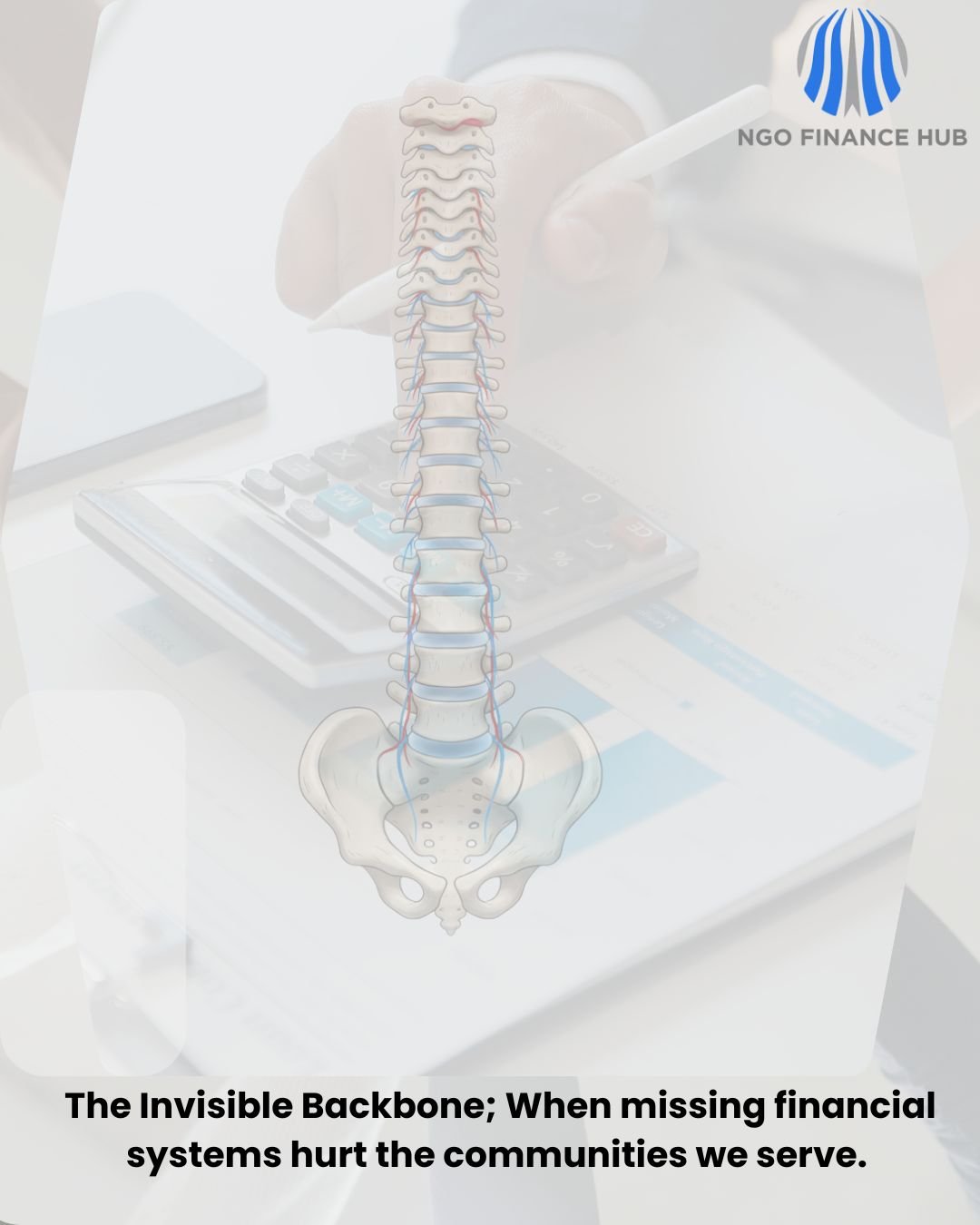
I have always been fascinated by the human backbone; reading about how the spine holds the body upright, how it withstands shock, how it allows movement without falling apart. I could also feel a sense of discouragement by the fact that something so important can go unnoticed unless it fails.
As a teenager, I thought this fascination might lead me to med school and career. I imagined myself studying anatomy, understanding how bodies work, learning how structure protects life. That path didn’t turn out the way I imagined. I didn’t become a doctor. My professional journey took me elsewhere, into finance, into organisations, into systems that exist far away from hospital corridors.
But I started to recognise the parallel of the backbone in finance, and the same logic began to apply in my work with nonprofits.
Not the numbers themselves, but the system behind them. The policies that shape. The buffers that withstand rainy days. The information flows that send signals. The governance that keeps everything aligned. The people who keep things going every day.
Do you know the anatomy of a human backbone? What about the organisational one?
Let me walk you through it. Fortunately or unfortunately I have a personal story to share for every part of it.
1. The Vertebrae: Structure that stands or falls
On my first day at that nonprofit, the budget proposal on my desk felt crystal clear. The project was prepared to provide free legal aid to 200 vulnerable individuals from the Roma community. At a time when access to legal aid from the state was extremely limited, this support was of a high importance. It meant representation in court, access to documentation, and a chance to find their way through very exclusive systems.
The financial structure behind the project was straightforward and familiar: salaries for lawyers and paralegals, documentation costs, court-appointed independent expertise, and administrative expenses. Every line had a purpose and every dollar was tied to an activity.
The organisation itself had been established as a programme of a big international organisation. The financial rules, cost calculations, and templates had been inherited from it. These rules worked like vertebrae: well defined, linked together, and made to support things.
Little did I know that these vertebrae had not been realigned in seven years.
Over time, the environment around them had shifted. Legal procedures had evolved, inflation had hit the country and finance and accounting rules had changed. But the structure remained untouched, difficult and presumed to be correct, simply because it once had been. What was great news when the project was approved, but quickly became clear something was off.
Some costs no longer matched the old categories, and others were more than we had planned for. Financial decisions were made not based on what the community needed, but on what the inherited rules would allow.
And just like in the human spine, misaligned vertebrae do not fail immediately. They create pressure, restrict movement and force the body to hold the pressure.
On paper, the project still promised support to 200 individuals. In practice, fewer people received help, at least timely. The financial structure had not failed spectacularly. It failed without anyone noticing at first.
That experience taught me that structure alone does not protect communities. It must be reviewed and adapted continuously. If not, even good systems push the burden somewhere else, onto staff, onto programmes, and ultimately onto the people the organisation exists to serve.
2. The Intervertebral Discs: Reserves and buffers
If the vertebrae give an organisation its structure, the intervertebral discs determine whether that structure can handle daily life.
In the human body, discs absorb shocks, soften impact and allow the spine to move, repair, and adapt without injuring itself. Without them, even the smallest movement becomes painful, and pressure goes directly from one bone to the next.
This is the story of an international foundation. Their focus was “empowerment of the community” and you could easily be inspired by how much passion was poured into the mission and the uninterrupted work done backstage. When I dove deep into their financial statements, the annual result was positive and I had a sense of relief that nothing could go wrong, until everything went wrong. Funds were disbursed quarterly, at least on paper, and all other expenses from salaries, to rent and programme costs were monthly. And the very well-known scenario of donor-funded programmes, reports were prepared later and there is always a time lag between spending and disbursement.
The staff existed under constant pressure of whether the payroll would be processed on time, or if the community would hang on tight on the promise of “soon”.
From the outside, the programme still existed but from the inside, it was constantly adjusting its posture to avoid pain. The communities never saw the cash-flow forecasts or the email chains with donors, as they would never knew why a legal clinic arrived later than promised, or why a follow-up visit did not happen. The organisation didn’t have reserves that would prevent the transfer of financial shock to people who have no responsibility for donor timelines or internal constraints.
Without intervertebral discs, the spine becomes inflexible, movement slows, and over time the body does less. The same happens with organisations, and that’s why reserves matter. They determine whether an organisation can carry on with its mission without passing the strain onto the people it exists to serve.Webinar Registration – Zoom: The Invisible Backbone; When missing financial systems hurt the communities we serve.
3- The Spinal Cord: When information fails to get through
In the human body, the spinal cord carries signals that allow the body to respond in time. When those signals are delayed or altered, the body does not collapse immediately, it hesitates, reacts too late, or moves in the wrong direction.
I recognised the same pattern in organisations where financial information existed but did not get through well. Reports were produced, spreadsheets maintained, balances tracked, yet decision-makers rarely had timely big financial picture. Financial knowledge sat in the head of one person, and decisions were often made based on guesswork.
When information doesn’t arrive on time, adjustments are impossible to be made. I saw that program expansion was often delayed, and other activities went on longer than they should because the risks weren’t noticed.
The funny part is that financial statements were still balanced and on paper the organisation was doing very well. But, in community work, timing of the information affects decision making about the when and how to support the people who need it most.
4- The Ligaments and the Muscles: When systems depend on individuals
In the human body, ligaments maintain alignment while muscles provide strength and movement. When one compensates for the other, the body may still function, but the strain accumulates quietly. I came to understand this dynamic most clearly when I went on maternity leave.
I was proud of knowing every single detail of the activities, donors’ behaviour, staff, board, and communities, as I had become the connective tissue of the system, just like muscle and ligament. When I stepped away, my outstanding colleagues tried to keep the ball rolling, but as everything was in “my head”, the questions that no one could answer with certainty increased and increased.
And like a snowball, one issue would bring another. I found myself answering phone calls and emails while breastfeeding my newborn, and I honestly didn’t feel like a superhero at all.
Communities never knew about my maternity leave or the internal uncertainty. They only experienced the results: support arriving late, programmes not being delivered on time, and responses not being responsive at all.

A backbone that holds
A backbone is not meant to be seen; it exists to carry weight, soften shock, and allow movement without failing. When it works well, we focus on what the body can do, not on the structure behind it.
Financial systems in organisations function in the same way. Their strength is measured by their ability to protect people, staff, partners, and communities from pressures they did not create. When those systems are outdated, inflexible, or dependent on individuals, the pressure spreads. As a result, it slows decisions, limits commitments, and slowly reduces impact.
This is why financial management matters not merely as an administrative necessity, but as an ethical responsibility, an invisible backbone that determines whether organisations stand upright under pressure or repair in ways that others, often those least equipped to soften the pressure, must carry.
In the end, strong communities rely on systems that hold up.
Join The Nonprofit Hive community for insightful discussions and valuable connections. Share your own experiences and insights or sign up for an upcoming Hive Chat to connect with others. Together, we can be stronger and prepared for anything! Join today